
Master Your Growth: The Ultimate Guide to Accounting & Tax Services in India
- April 8, 2026
- Posted by: admin
- Category: Business plans
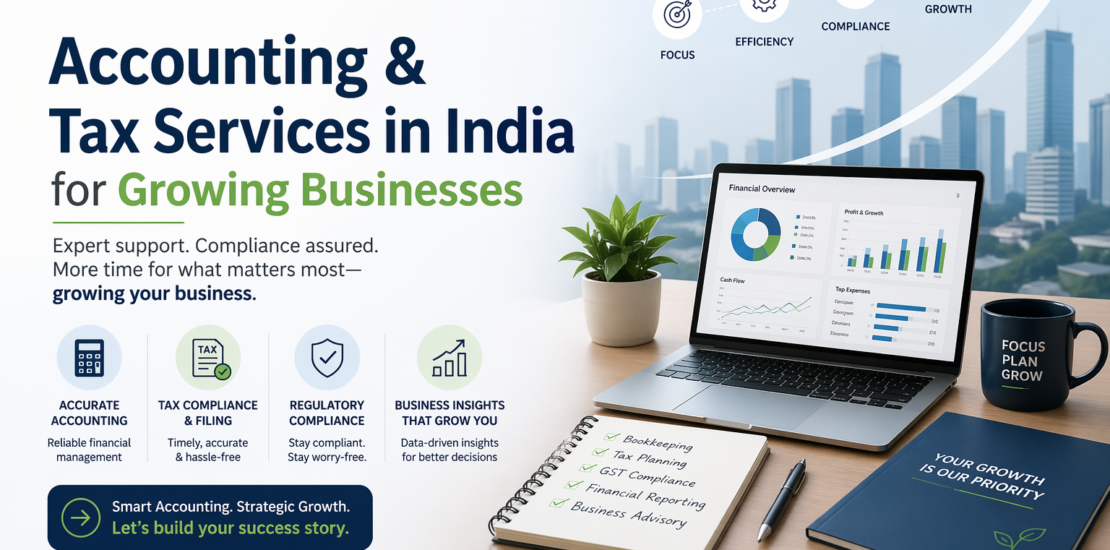
In the high-velocity world of Indian business, where “Unicorn” is a common household term and digital transformation is the baseline, many growing companies hit a glass ceiling not because of a lack of customers, but because of a tangled web of financial non-compliance. With the Indian economy projected to grow at a steady 10% nominal GDP rate through 2026-27, the stakes for financial accuracy have never been higher. For tech enthusiasts and small business owners, accounting is no longer just about “keeping the books”—it is about navigating an AI-driven GST ecosystem, optimizing tax liabilities under the New Income Tax Act, and ensuring that your financial health is robust enough to attract the next round of funding.
1. Navigating the AI-Driven GST Ecosystem
The Goods and Services Tax (GST) landscape in 2026 is a far cry from the manual filings of the past. The GSTN portal now utilizes advanced AI to automatically reconcile GSTR-3B claims with GSTR-2B data in real-time. For a growing business, this means that a single mismatch between your purchase register and your supplier’s filings can lead to an immediate block on Input Tax Credit (ITC).
- The E-Invoicing Mandate: In 2026, the threshold for mandatory e-invoicing has expanded, bringing more small businesses under the requirement to generate an Invoice Reference Number (IRN) for every B2B transaction.
- Real-time Compliance: Missing three consecutive monthly returns now triggers an automatic suspension of your GSTIN, effectively halting your ability to generate e-way bills or move goods.
To stay ahead, businesses are moving away from manual entry and toward Tokyo Consulting Firm’s integrated accounting solutions, which ensure your data aligns perfectly with the government’s digital scrutiny.
2. Tax Optimization in the “New Income Tax Act” Era
The 2026 fiscal year has introduced significant shifts in corporate taxation. While base rates remain competitive to foster the “Make in India” initiative, the focus has shifted toward rationalizing deductions.
- MAT and Startups: The Minimum Alternate Tax (MAT) rate has been streamlined to 14%, but the rules for credit accumulation have tightened.
- Share Buybacks: All share buybacks are now taxed as capital gains, a critical change for tech startups that previously used buybacks as a tax-efficient way to reward promoters and investors.
- Global Cloud Services: New tax holidays for foreign companies providing cloud services through Indian data centers offer a unique opportunity for tech-heavy businesses to structure their digital infrastructure cost-effectively.
Strategic tax planning isn’t about evasion; it’s about utilizing these specific legal provisions to improve your bottom line.
3. The Power of Outsourced “Strategic Finance”
For a growing business, hiring a full-time, high-level CFO and a dedicated tax team is often cost-prohibitive. However, the “talent shortage” in 2026 has made high-quality internal recruitment even more difficult. This is where Managed Accounting Services provide a competitive edge.
| Feature | In-House Accounting | Outsourced (TCF India) |
| Cost | High (Salary + Benefits + Tech) | Predictable Service Fee |
| Technology | Often Outdated | Cutting-edge AI & Cloud Tools |
| Scalability | Slow to adapt | Scales with your transaction volume |
| Compliance | Dependent on individual knowledge | Team of specialized experts |
Outsourcing allows leadership to focus on product-market fit while experts handle the complexities of TDS/TCS rationalization and annual audit defense.
4. Financial Due Diligence: Preparing for Funding
In 2026, venture capitalists and banks are more cautious than ever. A “clean” GST history is now a prerequisite for due diligence. If your financial records show inconsistent filings or un-reconciled ITC, it raises immediate red flags regarding your operational integrity.
Professional accounting services ensure that your Balance Sheets and Profit & Loss statements are not just accurate, but “investor-ready.” This includes maintaining clear trails for foreign assets and ensuring compliance with the latest disclosure schemes for small taxpayers.
Conclusion
As India marches toward its “Viksit Bharat” goals, the margin for error in financial management is shrinking. For growing businesses, accounting and tax services are no longer back-office burdens—they are strategic tools for survival and expansion. By prioritizing digital compliance, staying updated on the latest Finance Bill amendments, and leveraging professional expertise, you can transform your finance department from a cost center into a growth engine.
Ready to streamline your financial operations? Don’t wait for a scrutiny notice to take action. Explore our comprehensive Accounting & Taxation Services and take the first step toward hassle-free growth.
FAQ: Common Questions on Indian Business Compliance
Q1: Is e-invoicing mandatory for my small tech startup?
Ans. As of 2026, e-invoicing is mandatory for businesses with an annual turnover exceeding ₹5 crore. However, even if you are below this threshold, adopting e-invoicing is recommended to ensure your B2B clients can claim their Input Tax Credit without friction.
Q2: What are the penalties for late GST filing in 2026?
Ans. Late fees for GSTR-3B are generally ₹50 per day (capped at ₹5,000), but the real “hidden cost” is the 24% annual interest on unpaid tax liabilities and the potential for GSTIN suspension.
