
Legal & Compliance Services in India for Companies
- April 22, 2026
- Posted by: admin
- Category: Business plans
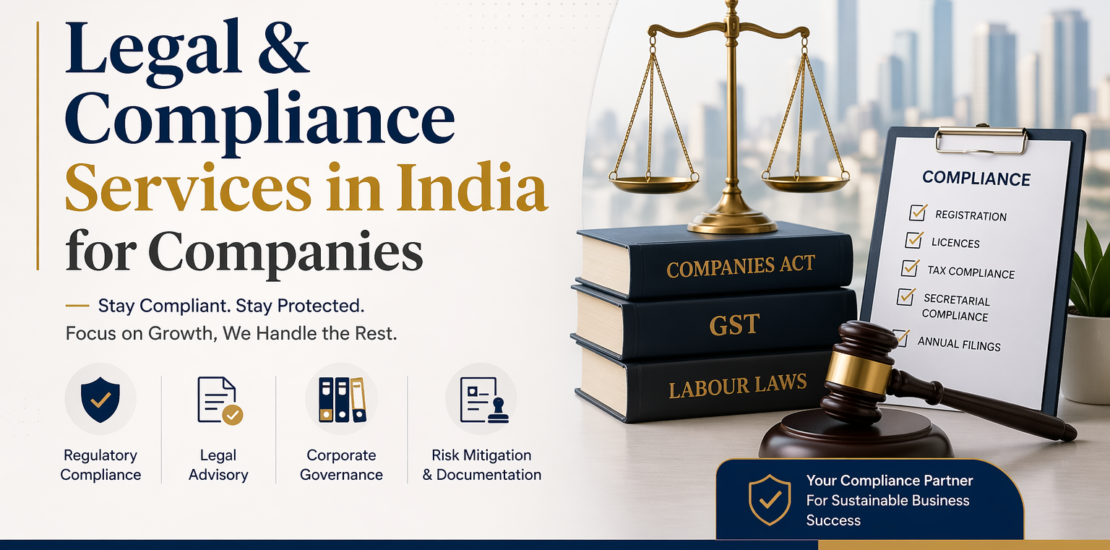
Why legal compliance is a silent growth engine in India
In 2025, India saw over 11,000 startups shut down, many not because of weak ideas but because of unresolved legal and regulatory issues. At the same time, the Ministry of Corporate Affairs (MCA) and the GST regime have tightened reporting timelines, while the new Digital Personal Data Protection (DPDP) Rules 2025 impose fines of up to ₹200 crore for severe data‑privacy failures.
For tech enthusiasts and small‑business owners, this makes one thing clear: legal and compliance services are no longer “back‑office drudgery” — they’re a core part of your business infrastructure. In this post, you’ll see how structured legal & compliance support can de‑risk your company, reduce fines, and even make your business more attractive to investors.
1. What legal & compliance services in India actually do
Legal and compliance services for companies in India typically cover three layers: forming the right legal structure, maintaining day‑to‑day regulatory obligations, and managing risk through contracts and policies.
For a typical tech startup or small business, a compliance‑focused service provider will help you:
- Company structuring and registration
- Choosing between LLP, private limited, OPC, or branch of a foreign company.
- End‑to‑end company incorporation under the Companies Act, 2013 via MCA’s SPICe+ (Simplified Proforma for Incorporating a Company Electronically).
- Ongoing statutory filings
- ROC filings: annual returns (Form MGT‑7), financial statements (Form AOC‑4), and event‑based forms such as director appointments, share allotments, and address changes.
- Penalties for non‑filing: missing ROC deadlines can attract daily fines of ₹100, capped at up to ₹5 lakh for annual returns and ₹10 lakh for financial statements, plus personal liability on directors.
- Tax and GST compliance
- GST registration, return filing (GSTR‑1, GSTR‑3B), and reconciliation of input tax credits.
- TDS/TCS filings and annual information returns, which are now critical triggers for scrutiny.
A professional legal‑compliance partner acts like your “regulatory co‑pilot” — helping you stay ahead of deadlines, avoid penalties, and keep your corporate records clean for audits and fundraising.
2. Key compliance areas every Indian company must watch
MCA and ROC‑level compliance
Under the Companies Act, 2013, authorized capital, turnover, and type of company determine how intense your compliance cycle becomes.
Common obligations include:
- Holding board meetings (typically four per year for most companies; some “small‑company” categories now allow two).
- Filing annual financial statements and annual returns within fixed due dates; late filing can push up GST and income‑tax scrutiny.
- Keeping statutory registers (minutes, share registers, director details) and updating them whenever changes occur.
Tax and GST traps for small businesses
The GST regime has made monthly or quarterly filings mandatory for most businesses, with interest of 18% per annum on delayed payments.
A common pitfall is mismatched input tax credits, which can lead to demands even years later. For example, a Bengaluru SaaS startup faced a ₹28 lakh GST demand after three years due to unreconciled GST‑2B and invoice data.
Regular compliance checks, especially for:
- GST‑2B‑purchase reconciliation
- e‑invoicing once turnover crosses ₹5 crore
- TDS‑TCS filings and annual information returns
…can turn a ticking‑time‑bomb of liabilities into a clean, audit‑ready tax profile.
Labour and employee‑law compliance
Labour‑law compliance has become more detailed, especially for companies with offices across multiple states.
Recent MCA rules now require companies to disclose:
- Sexual harassment complaints and maternity‑benefit compliance in their annual filings.
- Workforce‑related statistics such as headcount, gender diversity, and CSR‑driven benefits.
For small businesses scaling up remote and hybrid teams, this means:
- Drafting clear employment contracts and policies (leave, code of conduct, remote work).
- Ensuring PF, ESIC, and gratuity contributions are filed on time to avoid higher penalties and reputational risk.
Data privacy and cybersecurity under DPDP
The DPDP Act and Rules 2025 have turned data‑privacy compliance into a board‑level concern.
Key obligations for tech‑heavy businesses include:
- Reporting data breaches within 48 hours to the Data Protection Board.
- Maintaining year‑long logs and systems for automated data‑deletion upon user request.
- Special rules for children’s data, which can attract higher fines.
Companies that proactively build data‑privacy into their product design and onboarding workflows are better positioned to close customer deals, pass vendor audits, and attract privacy‑conscious investors.
3. How structured legal‑compliance support saves money and risk
Hiring a full‑time legal head or in‑house compliance team is often too expensive for early‑stage companies. Instead, many Indian tech startups and small businesses now outsource legal & compliance services to expert partners.
Such services can:
- Reduce penalties
- Automated dashboards and deadline trackers help you avoid late‑filing penalties on ROC, GST, and TDS.
- Speed up due diligence for funding
- Clean MCA records, updated KYC, and clean tax filings make it easier to close angel, VC, or bank‑debt rounds.
- Prevent disruption
- Regular audits and reconciliation lower the risk of bank‑account freezes or sudden tax demands that can freeze operations.
For example, some corporate‑compliance providers in India now offer bundled packages covering MCA filings, GST, TDS, and labour‑law checks under one subscription, which can cut both cost and management overhead.
If you’re a founder or small‑business owner in India, think of legal & compliance services as insurance plus growth fuel: you pay a predictable fee to avoid large, unpredictable risks and unlock smoother expansion.
4. How to choose the right legal & compliance partner in India
When evaluating legal & compliance service providers in India, ask:
- Scope of services
- Do they cover incorporation, MCA filings, GST, labour law, and data‑privacy, or just one area?
- Technology stack
- Do they offer online dashboards for tracking deadlines, filings, and compliance status?
- Domain expertise
- Do they have experience with tech startups, SaaS, e‑commerce, or PM‑to‑1 commission agents, or just generic corporate law?
For small businesses and tech‑focused founders, a partner that understands product‑centric compliance (like data‑privacy, online‑contract workflows, and platform‑specific regulations) is far more valuable than a purely “paper‑pushing” firm.
If you are exploring legal & compliance services in India, you can start with a free trial or registration for end‑to‑end support via Tokyo Consulting Firm’s India‑specific offerings: https://www.tokyoconsultingfirm.com/India/ — where you can register for tailored MCA, GST, and startup‑compliance packages.
5. Turning compliance into a competitive advantage
Compliance is no longer a “nice‑to‑have box” that founders ignore until a tax notice or investor notice arrives. With stricter MCA norms, GST scrutiny, and heavy‑duty data‑privacy rules, proactive legal & compliance management is now a differentiator.
For tech enthusiasts and small‑business owners in India, the strategy is clear:
- Treat legal & compliance as part of your product roadmap — not as a separate, scary chore.
- Use a single‑point partner for MCA filings, tax, labour, and data‑privacy so you can focus on building and selling.
- Start early — it’s far cheaper to build clean records from Day 1 than to clean up years of lapsed filings.
If you want to explore how structured legal & compliance services can be tailored to your India‑based company, visit Tokyo Consulting Firm – India services and register for a free trial or initial consultation to get started.
FAQs: Legal & Compliance Services in India
Q1. How much does legal & compliance support typically cost for a small business in India?
Ans. Costs vary by service provider and package, but many firms offer monthly retainers (₹10,000–₹50,000+) covering MCA filings, basic GST support, and check‑ins. Larger or high‑risk businesses may pay more for dedicated virtual‑CLO or privacy‑officer services.
Q2. Can tech startups skip compliance if they are bootstrapped or very small?
Ans. Legally, no. Even very small companies must comply with ROC filings, GST thresholds, PF/ESIC limits, and data‑privacy rules. The main difference is the frequency and intensity of compliance, not the exemption.
Q3. What happens if a company misses MCA or GST filing deadlines in India?
Ans. Late or unfiled ROC filings can attract daily penalties of ₹100, capping at lakh‑level fines for the company and directors. Delayed GST filings can lead to interest at 18%, late‑fee demands, and even restrictions on filing ITC or refunds.
By integrating professional legal & compliance services into your India‑based business model, you don’t just avoid penalties — you build a clean, investable, and scalable platform that regulators, customers, and investors trust.
