

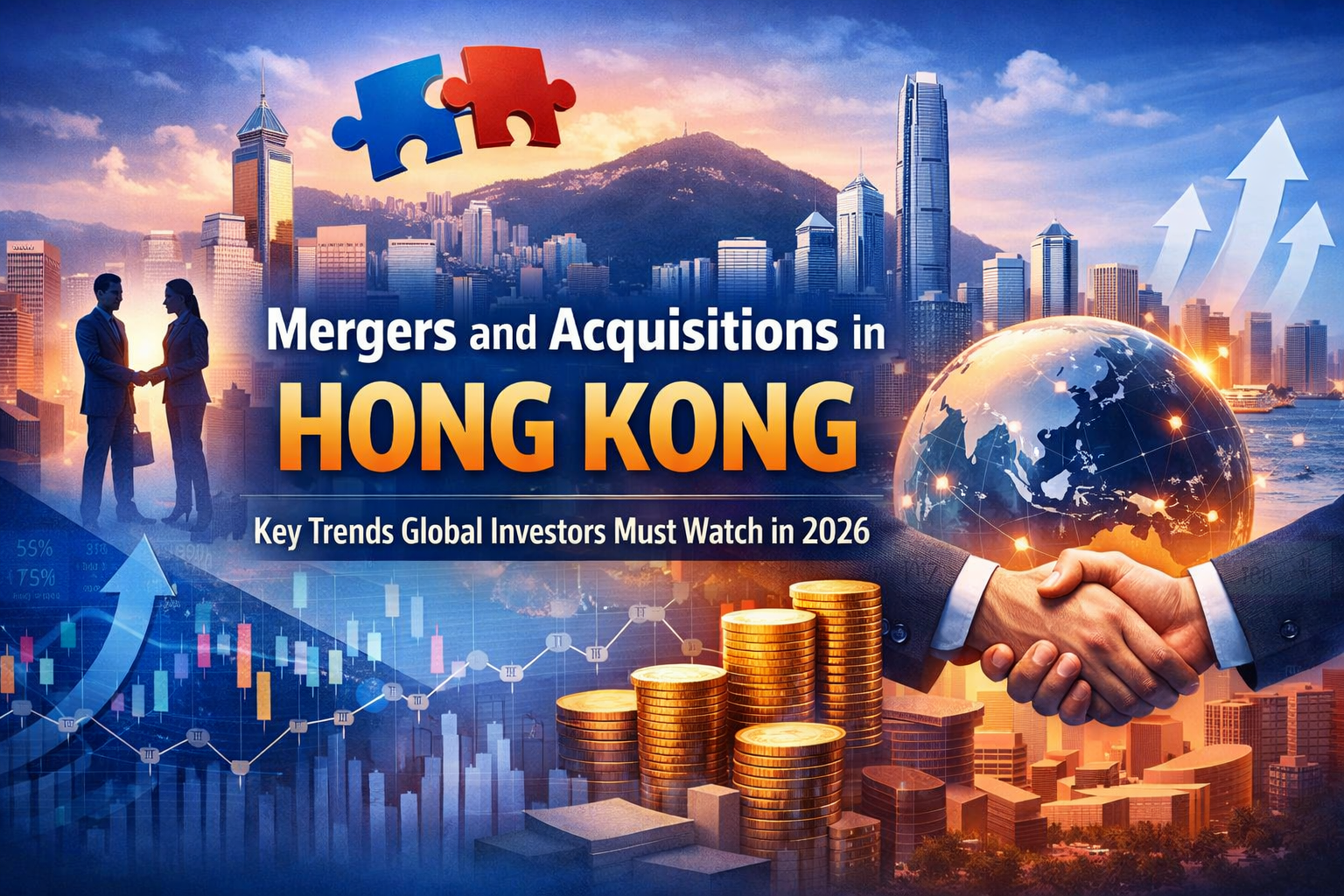
12 Feb The Digital Handshake: Mergers and Acquisitions in Hong Kong 2026
The tide has turned for dealmaking in the Pearl of the Orient. As we navigate 2026, the Hong Kong Mergers and Acquisitions (M&A) landscape has shifted from the “wait-and-see” caution of previous years to a high-velocity execution model driven by stabilized interest rates and a surge in tech-sector consolidation. With the Hong Kong Stock Exchange (HKEX) projected to see a record 150 listings this year and a renewed focus on the Greater Bay Area (GBA) integration, global investors are eyeing the city not just as a financial hub, but as a primary laboratory for AI-integrated transactions. This year, the success of a deal isn’t just measured by the EBITDA on a balance sheet; it is defined by a “Digital-First” due diligence process and the target’s ability to manage its digital footprint.
- The Rise of AI-Powered Due Diligence and “Full Population” Testing
Traditional M&A due diligence used to rely on sampling—reviewing perhaps 10% of a target company’s contracts and transactions to estimate risk. In 2026, that “educated guess” is no longer enough for sophisticated global investors. We are seeing a massive shift toward AI-powered “Full Population” testing, where 100% of a target’s data—from supply chain invoices to employment contracts—is audited in real-time.
Modern tools like Reputation Management Software have become indispensable in this phase. Beyond just financial audits, investors are now using sentiment analytics to scan years of digital interactions. By analyzing the “tone” of customer feedback and employee Glassdoor reviews, acquirers can identify cultural toxicity or brand erosion before the first LOI is even signed. In a market as compact and reputation-heavy as Hong Kong, these digital benchmarks are often more predictive of future success than historical revenue.
- Reputation Management: The New ESG Frontier
For tech enthusiasts and small business owners looking to exit, your “reputation score” is now a line item in your valuation. Global investors in 2026 are prioritizing targets with high digital resilience. This is where Reputation Management Software provides a competitive edge over traditional PR tools.
While legacy tools focused on “damage control,” 2026 features include:
- AI Reviews & Auto-Responses: Demonstrating an active, engaged relationship with the customer base.
- Omnichannel Dashboards: Centralizing feedback from WeChat, WhatsApp Business, Google, and niche industry forums.
- Competitive Benchmarking: Providing a real-time “Reputation Gap” analysis against industry leaders.
In the context of Hong Kong’s new Protection of Critical Infrastructures Ordinance, a clean digital reputation is often seen as a proxy for robust cybersecurity and operational integrity.
- Strategic Consolidation in the GBA and Tech Sectors
The “Buy and Build” strategy is the dominant theme of 2026. Rather than one-off transformative megadeals, investors are focusing on vertical software consolidation. We are seeing a particular interest in “Sovereign AI” assets—companies that meet local data residency requirements and serve the regulated sectors of the Greater Bay Area.
Investors are specifically looking for:
- Fintech & Web3 Integration: Following the 2026 Virtual Asset Custodial Regime, traditional banks are acquiring agile startups to bridge the gap between fiat and digital assets.
- Logistics & Industrial Automation: Companies that facilitate the physical flow of goods across the HK-Mainland border are high-value targets for private equity firms.
- Digital Infrastructure: Data centers and regional cloud providers are seeing “AI-readiness premiums” added to their valuations.
- Navigating the 2026 Regulatory Maze
Hong Kong’s regulatory environment has evolved to reward transparency. Key updates for this year include the Treasury Share Inventory rules, allowing listed companies to hold repurchased shares for use in future bolt-on acquisitions. This provides boards with the agility to act fast on mid-market opportunities without the friction of new share issuances.
Furthermore, the eMPF Transition—which became fully mandatory in late 2025—is now a standard due diligence checkpoint. Any target company that hasn’t fully migrated its HR and pension data to the eMPF platform faces significant “data integrity” penalties that can quickly sour a deal. At Tokyo Consulting Firm (Hong Kong), we specialize in ensuring your corporate structure is not just compliant, but optimized for these 2026 mandates.
Expert Insight: “In 2026, a deal doesn’t fail on price; it fails on data integrity and the inability to prove brand sentiment through verifiable analytics.”
Conclusion: Seizing the 2026 Opportunity
The Hong Kong M&A market has entered a new era where technology and reputation are the primary currencies. For global investors, the focus has shifted to AI-driven insights and the strategic use of Reputation Management Software to de-risk acquisitions. For business owners, the message is clear: your digital presence is your most valuable asset.
Whether you are looking to enter the Hong Kong market or preparing your business for a lucrative exit, navigating these trends requires a partner with deep local roots and a global perspective.
Ready to explore M&A opportunities in Hong Kong? Contact Tokyo Consulting Firm today for a Consultation or Free Strategy Session and ensure your business is 2026-ready.
FAQ: Mergers and Acquisitions in Hong Kong
Q1: What is the most critical due diligence step in 2026?
Ans. Beyond financial audits, verifying AI Data Provenance and Digital Reputation are now top priorities. Investors use AI tools to ensure that a target’s data was legally obtained and that its brand sentiment is trending positively across omnichannel platforms.
Q2: How does the new Treasury Share rule benefit M&A?
Ans It allows companies to use repurchased shares as “currency” for acquisitions. This makes “bolt-on” deals (smaller, strategic acquisitions) much faster and more tax-efficient, as it avoids the need for new shares to be authorized and issued.
Q3: Is the GBA integration still a major factor for global investors?
Ans. Absolutely. In 2026, many investors view Hong Kong as the “Sovereign AI” gateway. Acquiring a Hong Kong firm with dual-competency in HKFRS and CAS (Mainland accounting) provides a seamless entry into the larger Chinese market.
No Comments